 TEXAS A&M UNIVERSITY
MAJOR GRANT
If a proposed project costs more than $5,000 and/or will not be completed within six months of fund disbursement, applicants are encouraged to submit a Major Grant application to the Aggie Green Fund Advisory Committee (AGFAC). Applicants should ensure they have reviewed the application overview and are familiar with the evaluation criteria. Preference will be given to projects with strong student involvement and/or that demonstrate the greatest increase in Texas A&M University’s sustainability impact in a cost-effective manner.

Major Grant Abstract due November 2, 2026, 5 p.m. CST
Major Grant Abstract Preparation Document
Requirements
All proposed projects must meet the following requirements for active consideration:
- Projects must directly address sustainable improvements on the Texas A&M College Station, Texas A&M Higher Education Center at McAllen, and Texas A&M University School of Law campuses. Furthermore, the Aggie Green Fund is intended for sustainability projects that are not already funded by Texas A&M University.
- Projects may not primarily address research aims.
- Where appropriate, projects must have received written confirmation of support by campus officials prior to consideration (see Project Approval Form within the application).
- Projects that propose a change to the physical campus environment must align with the 2017 Campus Master Plan. Examples include permanently installing new equipment, constructing a garden, changing the appearance of a building, etc. If your proposal is selected, your project may be required to obtain approval from the Executive Facilities Committee / University Architect prior to funds being released.
- If a project requires Executive Facilities Committee / University Architect approval, the information package must be submitted by the applicant’s respective Dean or Vice President.
- Projects should align with the evergreen goals and targets of the 2018 Sustainability Master Plan.
- Projects must begin active project implementation by September 15 of the year they receive funding and reach project completion by August 31 of the following year. Projects requiring Campus Planning, Design & Construction / University Architect approval must begin active project implementation within 3 months and reach project completion within 18 months of receiving approval. Projects out of compliance with these requirements must return all funds to the Aggie Green Fund within 30 days unless they have applied for and received an AGFAC extension.
- All projects must have a mechanism for evaluation and follow-up after funds have been dispersed. At a minimum, a project plan must include a progress report and scorecard. If a project is expected to have ongoing benefits such as annual cost savings, the project plan must include a mechanism for tracking, recording, and reporting these benefits back to the AGFAC.
Application Process
The Major Grant application process is segmented into two phases: the abstract and the full application. Each item has different deadlines for submission. Reference the Application Timeline section below for deadlines. To submit your application, click the submission button at the top or bottom of this page.
Phase I - Abstract
The application process begins with completing an abstract. The abstract consists of basic background information on your project and allows the AGFAC to become familiar with you and your idea. The AGFAC will review your project and provide initial feedback to help guide you through the full application process. Below are the major sections of the abstract that you should be prepared to submit. For a full list of questions and to help prepare your abstract see this Major Grant abstract preparation document.
Project Description 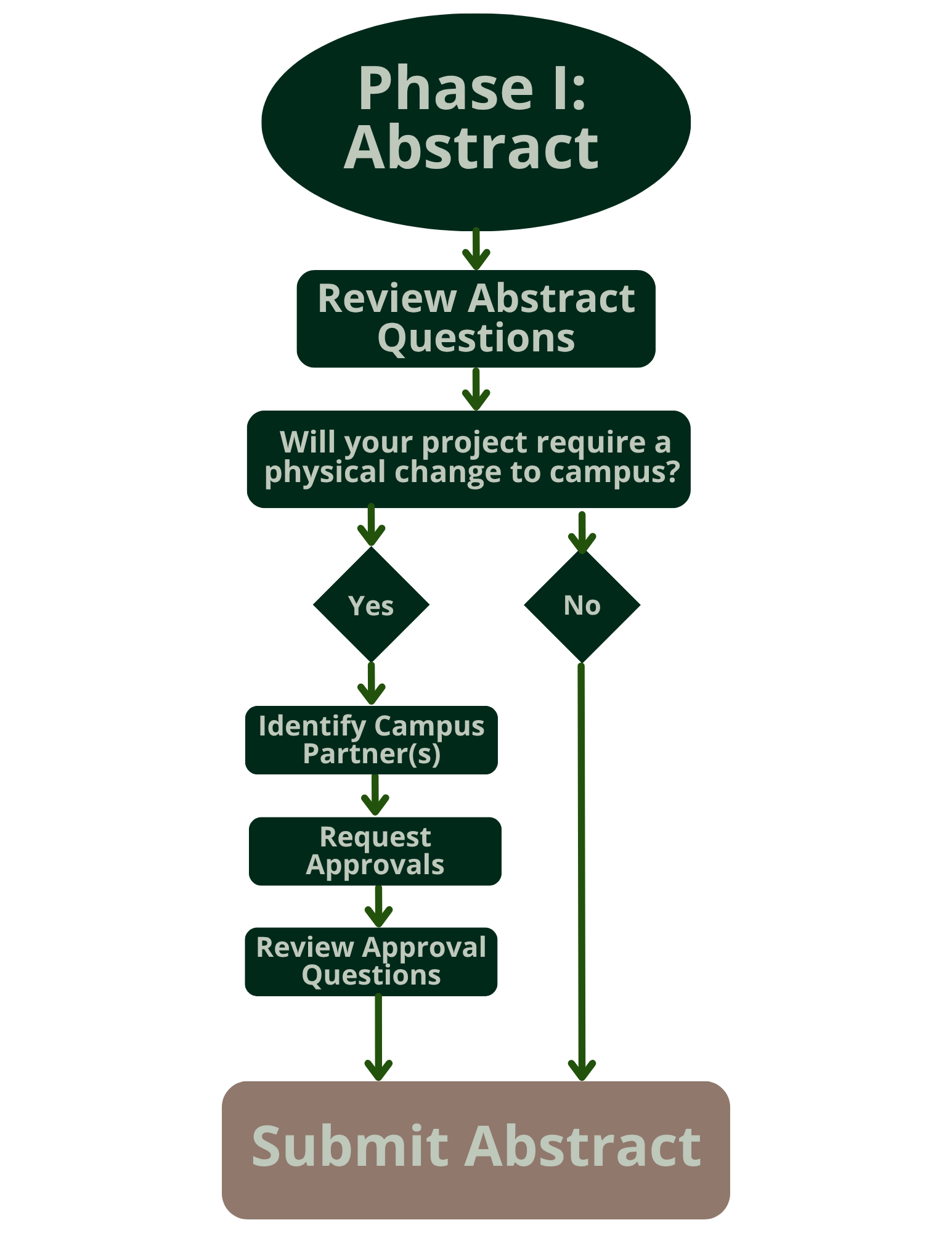
This section asks for a clear, compelling explanation of the project, its implementation plan, and its intended impact.
Project Budget
Be prepared to provide a brief summary of your projects estimated costs and major expenses.
Project Timeline
Be prepared to proivde a brief summary of your project timeline.
Project Approvals
You will be required to seek approval from the appropriate department or organization leader(s). Frequent approval entities include but are not limited to:
- Athletics – Oversees athletic events and programming
- Building Proctors – Oversee operations within their assigned buildings
- Chartwells – Oversees campus dining
- Dean (or delegate) and Department Head – Oversee academic learning and research opportunities for their school/department
- Facilities and Dining Administration - Oversee third-party vendors for building maintenance, custodial, dining, and landscape
- Environmental Health & Safety – Oversees hazardous waste and lab safety
- Recreation Sports – Oversees the Rec Center and associated programs
- Residence Life – Oversees campus residence halls
- SSC Services – Oversees grounds, custodial, and maintenance services
- Transportation Services – Oversees transit and parking
- University Architect – Oversees the Campus Master Plan and campus signage
- Utilities & Energy Services – Oversees energy, water, and recycling services
For the abstract, be prepared to list any campus entities that you will need approval from to implement your project and whether your project will require a physical change to campus. For any approvals you require you should have started the process to gain their signature on the Project Approval Form before submitting your abstract.
Phase II - Full Application
Following AGFAC approval of the abstract, applicants will complete and submit the full application. The application is an in-depth questionnaire that seeks to identify the various strengths and weaknesses of a proposed project. The application enables the AGFAC to ensure that AGF Funds are spent wisely and on projects that will provide the greatest benefit to Texas A&M University and its students.
If a project will require the participation of a campus department or impacts campus operations, applicants are required in their application to include approval(s) from the appropriate department or organization leader(s).
Project Description
This section requires you to clearly outline the goals, structure, and need your project addresses, along with a detailed description of the implementation process and phases. Furthermore, you are asked to describe the project's sustainability aspects and benefits to the Aggie community.
Education, Outreach, and Publicity Plan
This section asks you to detail your plan for educating the campus community about the project and its outcomes and to outline your strategy for promoting the project.
Metrics, Measurability, and Impact
This section asks for a detailed description of your project's quantifiable environmental, social, economic, and other impacts along with the metrics and methodology you will use to measure them. You will also have an opportunity to describe any expected qualitative benefits.
If your application is approved, you will be asked to complete a Scorecard form that will serve as the project’s impact measurement plan during the reporting period of your project. The Scorecard will include:
- 3 required impact objectives, including specific goals, measures, and methods for tracking progress.
- Up to 3 additional optional objectives.
- Up to 6 optional qualitative goals to capture outcomes or impacts that may be difficult to measure numerically.
You may choose to download the Scorecard template, in order to begin to prepare for submitting your scorecard upon approval. For additional guidance, see a Sample Scorecard and the Scorecard Help Sheet.
Budget
This section focuses on the project's financial plan by requiring a narrative budget explanation that justifies major costs and aligns with the uploaded, detailed budget spreadsheet and pricing support documentation. It also asks you to address the plan for ongoing funding beyond the grant, list any secured or pursued external funding and resources, and describe how the project can be scaled if only partial funding is awarded.
Use this Budget Sheet Template to detail the costs associated with accomplishing your project. Be prepared to upload this form with your application.
Timeline
You will be required to submit a list of milestones that will occur during your grant period. You will be required to submit four, but you can submit up to 10 milestones. You may use this Project Timeline Form to prepare the tasks associated with completing your project.
Location
This section asks you to describe the proposed location of your project and to upload a map (if applicable).
Project ApprovalsThis section asks for what entities will need to approve of your project and asks you to upload their signed approval forms. For projects that must secure the support of a Campus Project Partner, the Partner must check Box 3, at minimum, on the Project Approval Form.
Addressing Abstract Feedback
You will be given feedback on your abstract submission. In this section you are asked to describe how you addressed that feedback in your full application.
Application Timeline
Application deadlines for the Major Grant process vary slightly year-to-year. Deadlines for the most current cycle are as follows:
2026-2027
- October 1, 2026 - Abstract Submission Opens
- November 2, 2026, 5 p.m. CST - Abstract Submission Closes
- December 7, 2026 - Applicants Informed of Abstract Decisions
- December 7, 2026 - Full Application Submission Opens
- February 1, 2027, 5 p.m. CST - Full Application Submission Closes (by invite only)
- March 1, 2027 - Major Grant Recipients Informed
Abstract Submission Checklist
Are you ready to submit your abstract? Make sure by having all items on this checklist included in your Abstract submission. You may download this Word Document - Major Abstract Preparation to use when preparing your Major Grant abstract materials.- Answers to project description questions
- Outreach plan
- Measurability plan
- Budget summary
- Timeline
- Location description
- Amount requested
- Project approval(s) (if applicable)
Full Application Submission Checklist
Was your abstract accepted and you were invited to submit a full proposal? Make sure you have a full and complete application by including all items on this checklist. You may download this Word Document - Major Application Preparation to use when preparing your Major Grant application materials.- Answers to project description questions
- Detailed outreach plan
- Detailed impact measurement plan
- Filled out Budget
- Supporting Price Documentation
- Filled out Timeline
- Map of proposed project site(s)
- Campus approval form from relevant campus entities
- Answers for abstract feedback
The AGFAC looks forward to hearing your ideas and seeing the impacts that students, faculty, and staff can have on Texas A&M University’s campus. The Aggie Green Fund uses the Blackbaud grant management system for all project documents. Use the link below to submit all documents through the Blackbaud portal.
Abstract due November 2, 2026, 5 p.m. CST